



Kazakh artist Aisulu Dräger: Art, Identity and New Perspectives
Kazakh artist Aisulu Dräger shares insights into her work, her move from Kazakhstan to Germany, and the ideas behind her artistic practice.
Born and raised in Kazakhstan, artist Aisulu Dräger has spent the last years building a new life in the city of Halle/Saale in Germany while continuing her creative work. Her projects explore a wide range of topics, including social issues, women’s experiences, ecology, language, and cultural identity. In our interview with her, she speaks about her artistic journey, the challenges of adapting to a new country, her involvement in contemporary art projects in Kazakhstan and Central Asia, and the ideas that continue to shape her work today.
Info Shymkent: Hello Aisulu, you moved from Kazakhstan to Germany because of your marriage. In Kazakhstan, you were known as Aisulu Shaikenova. How did this major change, associated with moving to another country, affect your professional life? What challenges do you face in Germany?
Aisulu Dräger: Yes, in Kazakhstan not all women change their surnames, and for a long time I was also known as Shaikenova. But after marriage I consciously chose to take my husband’s surname. For me, it is about a sense of family and personal choice. Professionally, the transition was easy – people still recognize me. And I do not think this contradicts feminism, because feminism is about having the freedom to choose.
In Germany, the main challenge at first was the language barrier. Fortunately, I was able to complete integration courses, B1 German, history and politics classes, and later the B2 Beruf course. This helped me enormously. In the beginning, it was difficult to spend time in the company of German friends and within my husband’s family circle, because I could not express myself in the same way as I can in my native language.
I have also not yet participated in exhibitions in Germany, because nobody really knows me here yet. I regularly apply for open calls and exhibitions, but so far I have not been selected. During my time in Germany, I participated in a couple of exhibitions in Kazakhstan by sending my works online to the curators, and my family helped me as well to transport my work for one of my projects to an exhibition in Kazakhstan.
Info Shymkent: Let’s now talk about your first step into the world of art. Why did you decide to become an artist? What or who inspired you?
Aisulu Dräger: I have loved painting since childhood. Even in kindergarten, when I was three years old, my teacher told my mother that I had artistic talent. My sister, who is two years older than me, loved painting, too. When she draw people, I would sit across from her and copy her sketches – although my people often came out upside down.
Later we painted together at home all the time. At one point, it was difficult for my mother even to persuade us to go outside and play because we only wanted to paint. Then we studied with a couple of artists who had graduated from St. Petersburg’s Repin Academy of Arts, and later we entered art school. I studied there for four years alongside regular school, and already at that time I took my studies very seriously. During portfolio reviews, I sometimes stayed awake until morning finishing my works. I already knew for certain that I had chosen my profession.
I participated in exhibitions, won competitions, and at school I was often assigned to create wall newspapers and even excused from lessons for it. I loved this whole atmosphere and the passion for drawing – it felt like an entire world to me.
Speaking about contemporary artists, I am inspired by Louise Bourgeois, Almagul Menlibayeva, Maurizio Cattelan, and Bakhyt Bubikanova. I have been working in contemporary art since 2017. I always wanted to pursue contemporary art, and on my second or third attempt I was accepted into the School of Artistic Gesture in Almaty. The curators were Yulia Sorokina and Vladislav Sludskiy.
There were also three invited artists from England, Azerbaijan, and Poland who taught video art, land art, and performance art. I became deeply inspired, created my first installation, and participated in a contemporary art festival. That was when I became acquainted with the contemporary art scene of Kazakhstan and met curator Aigerim Kapar. As part of the Artcom community, I participated in contemporary art exhibitions in Astana, attended many lectures, and was especially inspired by lectures on the history of Kazakhstan and biology.
As members of Artcom, we also helped organize these lectures, so preparing exhibitions became a very deep and meaningful process for us.
Info Shymkent: You’ve participated in many large-scale artistic projects related to Kazakhstan’s history, women right, social life, and ecology. Can you tell us about the projects you’ve presented in Kazakhstan and Central Asia?
Aisulu Dräger: Yes, I truly have many works dedicated to these themes. One of them is Qustar Keldi (Kazakh for: The Birds Have Arrived). At that time, I was part of the Artcom community curated by Aigerim Kapar. We spent a lot of time studying the issue of the disappearing Taldykol Lake and wanted to draw public attention to this problem.
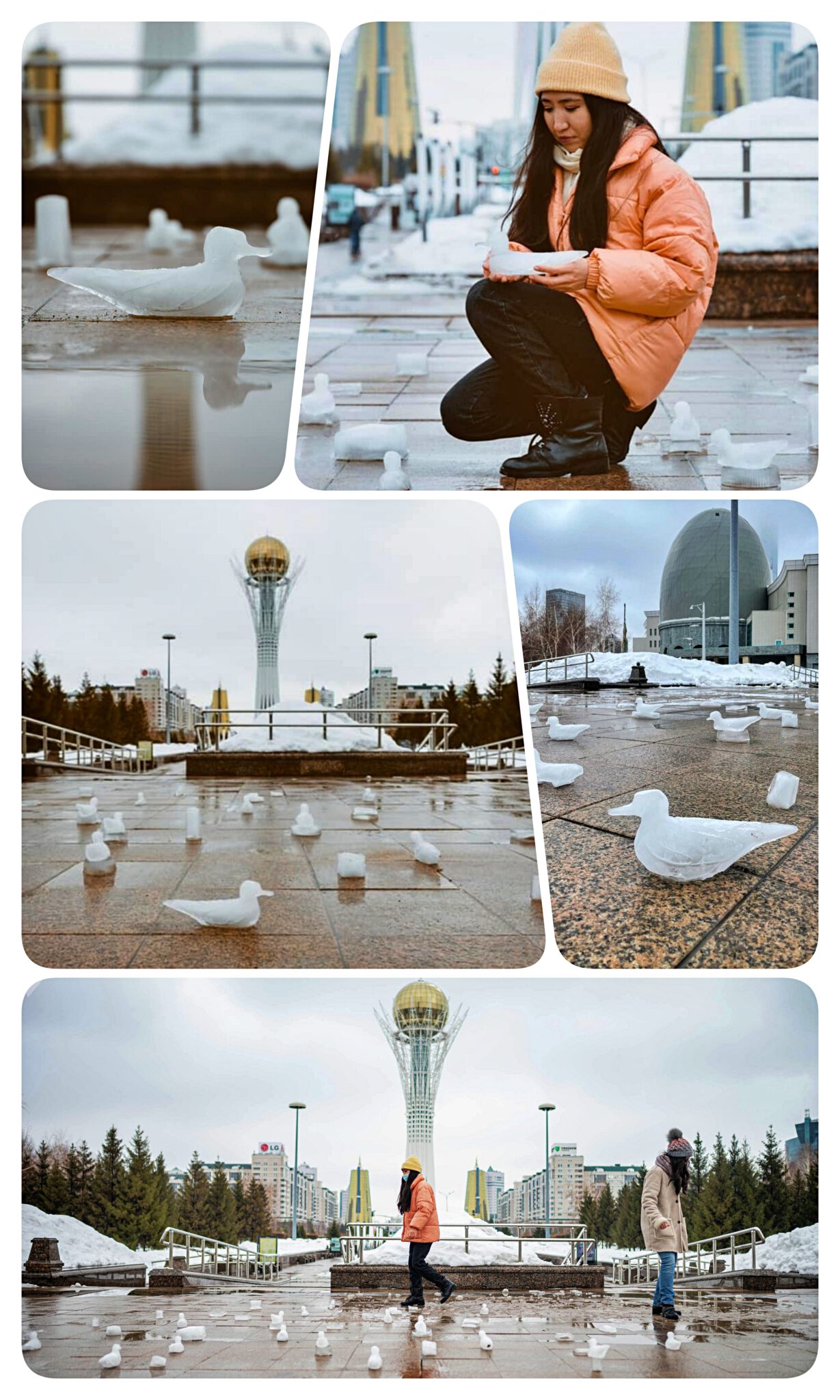
I came up with the idea of creating birds from the lake out of ice and exhibiting them in the city center against the backdrop of Baiterek Tower. Their melting symbolized the possible disappearance of the birds themselves.
I also created the Jaqyn Sozdik project connected to learning the Kazakh language through drawing. I organized meetings with residents living around the lake, where we painted the lake while simultaneously studying Kazakh. On the day of the performance, when I displayed the ice birds, I also created coloring pages about the birds and the environmental situation around the lake and distributed them in two languages.
It was important for me to recreate an actual bird from the lake, so I did not want to use a ready-made mold. I sculpted the bird myself and only afterward made a silicone mold to cast the water into ice sculptures. Technically, I was helped by my friend, the hyperrealist sculptor Aidos Yesmagambetov. He showed me how to work with silicone, and for me it was a complete experiment that ultimately succeeded.
There was only one mold, so I had to freeze the birds one after another, and the whole process took about a month. My freezer at home did not have enough space, so I also used the freezer of friends. Interestingly, this all happened during the COVID-19 period. When information about the performance leaked out, someone from the administration of Baiterek called my personal phone number on the day of the event and asked me not to carry out the action because of COVID-19 restrictions. I was warned that security would be there.
Nevertheless, I decided to continue, especially because members of Artcom had also come to help me carry the birds. In the end, I moved the action to Nurzhol Boulevard, while Baiterek still remained in the background just as I had envisioned. The performance received a huge response – major news portals and public pages wrote about it, and many people personally messaged me to thank me. Many were disappointed that they had not managed to see the installation before the birds melted away.
Another work, Newton’s Cradle, was also created during the COVID-19 period. In this piece, I placed inside the balls of Newton’s cradle objects that strangely comforted people during quarantine – masks, toilet paper, buckwheat… I remember how empty store shelves sometimes were at that time.
I also created the video artwork Zhok (Kazakh for: No), in which I walked from morning until night carrying a gramophone and repeatedly pronouncing a clear “no” in abandoned places as well as ordinary city streets. This work is about women and victims of violence. Victims are often blamed and subjected to victim-blaming, although it has been scientifically proven that under extreme stress a woman may physically be unable to scream or call for help. I also wanted to emphasize that neither the time of day nor the place matters – the victim is never guilty. In a way, I was saying “no” on behalf of all women.
There is also the work Being, an ironic piece addressing the serious issue of domestic labor. I often notice that within patriarchal systems women are expected to take on far too much responsibility – all the housework, childcare, caring for animals, and in today’s reality they also work professionally. This installation was created for the April Contemporary Art Festival in Bishkek curated by Ulan Japarov.
The festival format was light and humorous, while still addressing important issues. That year, all artworks had to involve toilet paper. I used the form of a handmade toy television – the kind where you rotate a pencil to watch a sequence of drawings move like a cartoon. My sister used to make these for me when we were children.
The installation consisted of two televisions: in one, a man resting on a sofa after work, and in the other, the endless tasks performed by a woman. The contrast was very visible. Of course, I am not saying that every marriage is like this, but while researching the topic I noticed that this dynamic appears quite often in Central Asian families.
Info Shymkent: Every project, every work of art, is like a part of the life and a part of the soul. Do you have a favorite piece of work you’ve made?
Aisulu Dräger: That is a very interesting question. For me, art is a form of therapy. When something troubles me deeply for a long time, I create a work about it, and afterward it becomes easier for me emotionally.
For example, before the age of twenty-seven, I was often affected by questions about marriage. Later I created a whole series of works dedicated to the choices women face: family, children, self-realization, or somehow balancing all of them together. After creating these works, I stopped reacting so painfully to those questions. The process itself became therapeutic for me.
Every artwork feels like a part of my soul, so it is difficult to name only one. But perhaps Zuleikha is especially important to me. In this work, I turned to history and told the story of Magzhan Zhumabayev’s wife, who risked her life to collect and hide her husband’s manuscripts inside mattresses. Thanks to her, his works survived, and she also fought for the rehabilitation of his name.
The installation was large and consisted of four traditional korpe mattresses covered with fragments of his literary works.

Info Shymkent: You also had experience as a fashion designer. What was the most challenging part of your work in fashion industry?
Aisulu Dräger: I completed an internship with Kuralai Nurkadilova and later worked as a costume artist in a theater for a full year, where I learned a great deal – how to choose fabrics suitable for the stage and how to create costumes that reveal the personality of a character.
In 2018, after three attempts, I became a finalist of Kazakhstan Fashion Week – New Generation – Open Way, where twenty finalists were selected from around one thousand participants across the CIS countries. It was a huge responsibility. The biggest challenge was the lack of time to produce the collection, even though it consisted of only two looks.
I balanced preparing for the show with my work as an art teacher at a studio. Although I had entrusted the sewing to a seamstress and even found someone to make the shoes for me, I still had to travel to purchase materials and go to Almaty for the show. Financially, it was all quite expensive, but I am very grateful for the experience. We had a strong mentor, Alex Zheng, and I feel lucky to have worked with him.
Info Shymkent: Today, we’re witnessing the evolution of artificial intelligence. Especially in recent years, we’ve seen Artifical Inteligence (AI) used to create “artworks” in just a few seconds. What’s your opinion of AI as an artist?
Aisulu Dräger: Of course, I also follow current trends. AI has already been used in art for quite a long time, and I have nothing against it, although I personally have not used it in my own works yet.
I observe artists such as Almagul Menlibayeva, who thoughtfully integrates AI into her projects in a way that does not diminish authorship – she still fully realizes her own artistic ideas through it.
When it comes to illustrations and paintings, I think it is usually obvious where AI was used and where a person created the work by hand, even digitally. Personally, I feel much closer to the second approach.
Info Shymkent: You currently have projects called Tengri Visions and Jaqyn Sozdik. Can you tell us more about them?
Aisulu Dräger: I created Jaqyn Sozdik while participating in a TEDx program curated by Aigerim Kapar and Georgian artist Vato Tsereteli as part of the project Next Reality.
Over the course of ten days, each of the fifteen women artists developed her own project. Mine focused on an issue that was personally painful for me – the Kazakh language. Unfortunately, I did not speak Kazakh very well, and in northern Kazakhstan, especially in Kokshetau, this is not unusual. That is why I decided to work with this issue, because many Kazakhstanis feel shy or insecure about speaking Kazakh.
During our meetings, we drew together while learning the language. At that time, because of COVID-19, the meetings were held online.

Tengri Visions is a collaborative project created together with my husband. He built the website where I publish illustrations featuring landscapes and cities of Kazakhstan. People can also order merchandise there, and my husband writes articles about Kazakhstan as well.
Info Shymkent: As the final question of this interview, we would like to ask you about Kazakhstan. As a Kazakh, what do you like in Kazakhstan and what do you miss abroad from your motherland? What places in Kazakhstan would you personally recommend tourists to visit?
Aisulu Dräger: First of all, I miss my family and friends. Speaking about what I miss specifically, sometimes in winter I long for snow like we had in Kokshetau. But you quickly get used to the weather here too – after all, warm winters are very convenient. We even had snowfall a couple of times, and I was genuinely happy about it. Honestly, it felt like enough snow for the whole season.
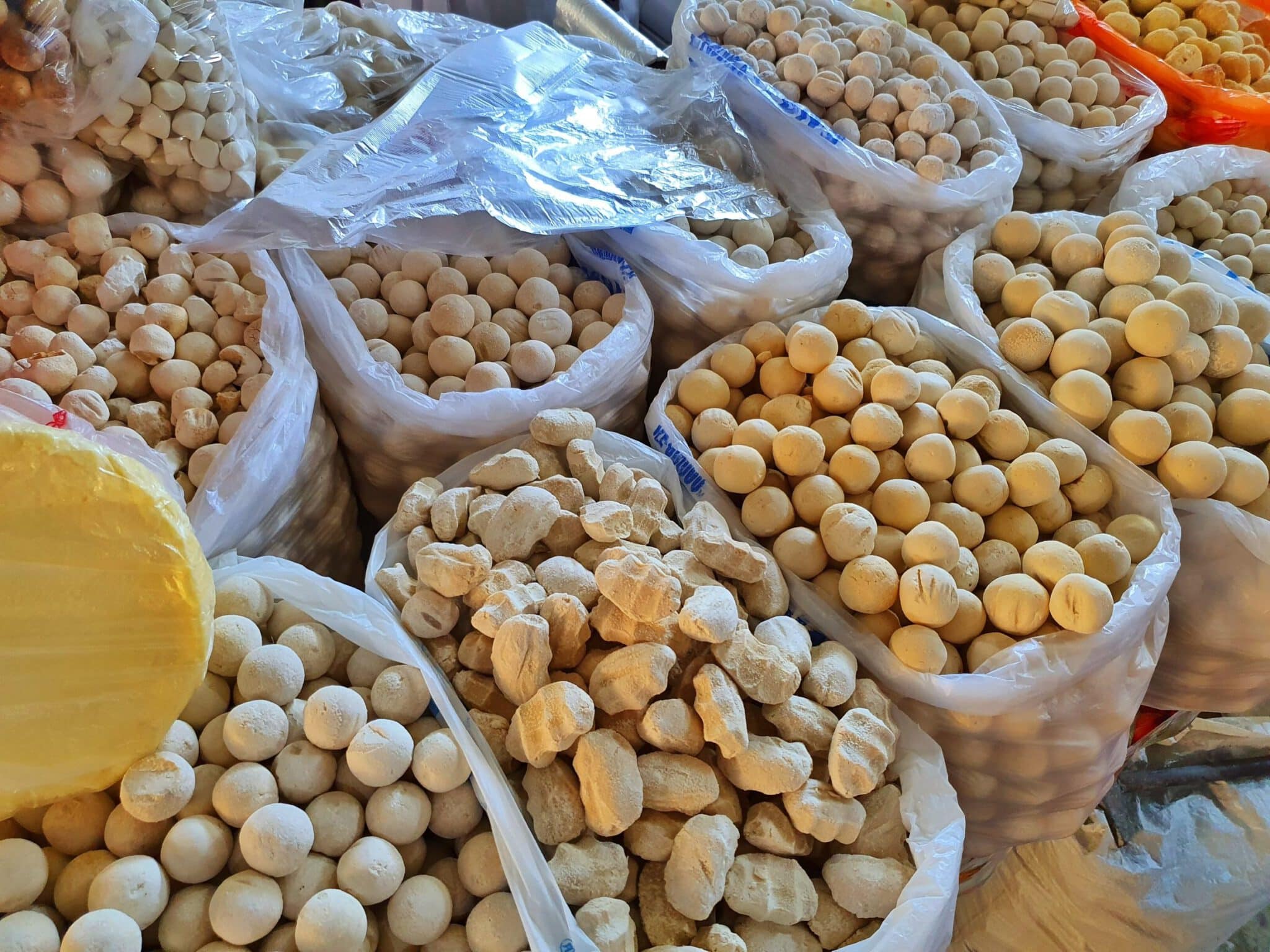
Sometimes I miss traditional foods such as et-nan, kumis, and qurt. We still cook our national dishes here as well, although of course I do not crave familiar food every day. I also enjoy the local cuisine.
Naturally, the mentality here is different, and that has both advantages and disadvantages. It is easier for me to communicate in Russian, and when speaking German I still cannot fully be myself yet. Even joking is difficult because I am constantly translating in my head. But little by little it becomes easier. I enjoy the process of learning and the fact that I now know more languages.
In Kazakhstan, I would definitely recommend visiting Burabay National Park – it is my favorite place, where I always feel recharged with energy. The seaside in Aktau is also incredibly beautiful. Bozzhira impressed me deeply – those almost cosmic landscapes are breathtaking. Bayanaul National Park, Lake Balkhash, Charyn Canyon, and Kolsai Lakes are all extraordinary places as well. Kazakhstan has so many beautiful destinations worth visiting.
Info Shymkent: Thank you very much for your interview, Aisulu! We wish you all the best for your new art projects and your new life in Germany.
You can learn more about Artist Aisulu Dräger on these websites:
- Aisulu Dräger’s Instagram account
- Tengri Visions (Art from Aisulu Dräger featuring landscapes & cities of Kazakhstan)